Are Human Cleaners Training Their Own Replacements?
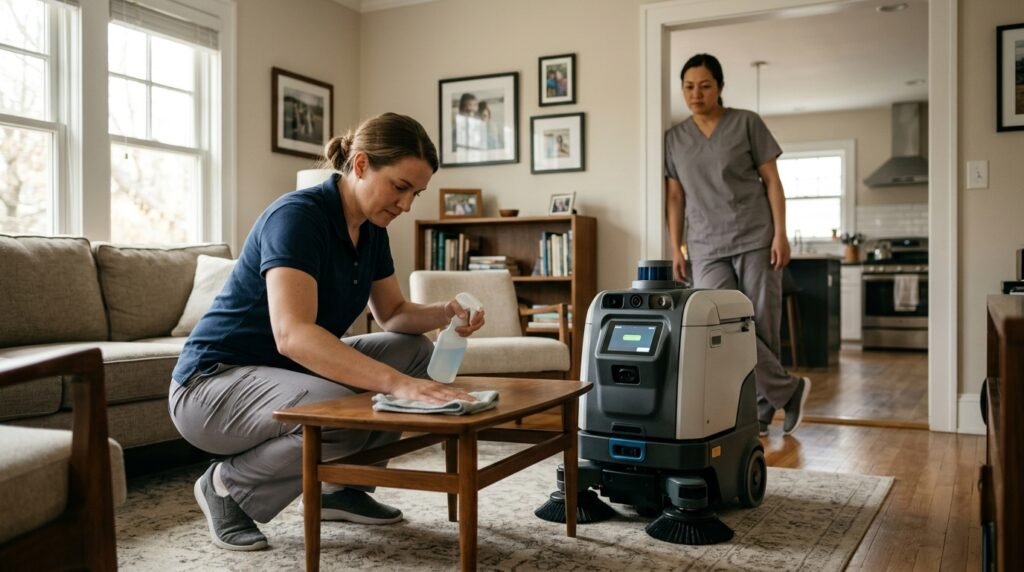
Imagine a cleaning professional showing a robot how to navigate a building, which areas to clean, and what a proper cleaning route looks like. It sounds like something from a science-fiction movie. But autonomous cleaning technology is becoming a real part of the professional cleaning industry.
That raises an uncomfortable question: Are human cleaners helping train the technology that could eventually replace them?
Cleaning Robots Are Already Here
Autonomous cleaning machines aren’t just experimental gadgets anymore.
Commercial cleaning robots can navigate spaces, follow programmed routes, avoid obstacles, and handle repetitive floor-cleaning tasks with limited human intervention. The commercial cleaning robot market has been growing rapidly, driven in part by labor shortages and the need to improve efficiency.
The technology is particularly useful in large commercial environments such as airports, hospitals, warehouses, shopping centers, and office buildings.
But that doesn’t necessarily mean a robot is about to take over an entire cleaning job.
What Are Human Cleaners Teaching Them?
Before a machine can work effectively in a real environment, someone has to help determine what it should do.
Human workers may help map facilities, define cleaning routes, identify problem areas, monitor equipment, and adjust workflows.
In other words, cleaners aren’t necessarily training their replacements. They’re often helping organizations figure out how humans and machines can work together.
Some facilities are even using digital maps and virtual walkthroughs to train new employees while also preparing the environment for autonomous equipment.
Robots Are Good at Repetition
There is one area where robots have a clear advantage: repetitive work.
Large floor areas are a perfect example. A robotic scrubber can repeatedly follow a defined route without getting tired or distracted. That can free human workers from spending hours performing the same movement over and over.
The goal isn’t always to remove the person from the process. In many operations, the person moves into a different role: monitoring the machine, handling exceptions, checking quality, or taking care of tasks the robot can’t perform.
But Cleaning Is More Than Following a Route
A home or building isn’t a perfectly predictable environment. A spill appears where it wasn’t supposed to. Furniture gets moved. Someone leaves something in the hallway. A particular surface needs a different cleaning method. Human cleaners can look at a situation and make a decision.
They can notice that something looks wrong, determine why, and change their approach.
That kind of judgment is much harder to automate than simply moving a machine from point A to point B.
The Cleaner of the Future May Work With a Robot
This is where the idea of “replacement” gets complicated.
Instead of imagining a future where a robot completely replaces a cleaner, imagine a cleaner supervising several automated machines while focusing on the work that still requires human attention. Industry discussions around robotics increasingly describe this as a form of collaboration, with machines handling repetitive tasks while human workers focus on more complex work.
That could mean new skills become valuable in cleaning: operating technology, interpreting data, troubleshooting equipment, and managing automated workflows.
So, Are Cleaners Training Their Own Replacements?
Maybe but probably not in the way you think.
Human cleaners are helping shape how automation is implemented because they understand the work better than anyone designing a machine from a distance. Their experience can teach technology where the difficult parts of cleaning actually are. And as automation becomes more capable, some traditional cleaning tasks may disappear or change.
But that doesn’t mean the human role disappears with them.
The more likely future is a cleaning industry where technology handles more of the repetitive work while people handle the details, decisions, and unexpected situations that machines still struggle with.
The interesting question may not be “Will robots replace cleaners?”
It may be: “What will cleaners do when robots take over the most repetitive parts of the job?”
That answer is still being written, and human cleaners may be some of the people writing it.
Curious to see house transformations? Visit our Instagram to explore before-and-after photos from our recent cleaning projects.
Ready for a cleaner, healthier space?
Explore our cleaning services or request a free quote — Brilux serves homes and businesses across New Jersey & Pennsylvania.
Call or text us at (215) 515-5192, Monday–Friday, 8am–6pm.